
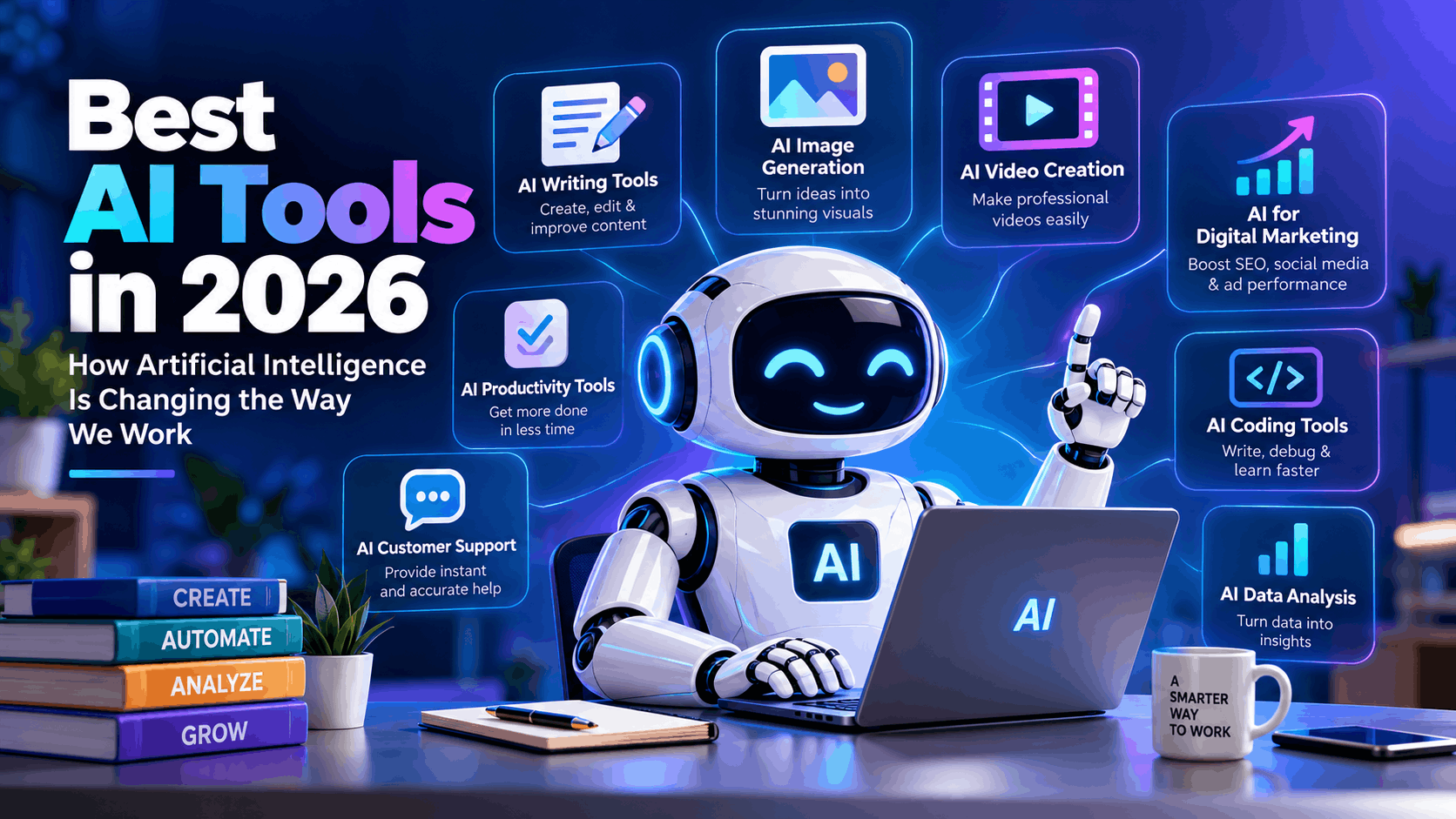
Discover the best AI tools in 2026 for content creation, marketing, coding, image generation, video creation, data analysis, productivity, and business automation.
Best AI Tools in 2026: How Artificial Intelligence Is Changing the Way We Work
Artificial Intelligence has moved far beyond being just a futuristic technology. Today, AI tools are helping businesses, marketers, developers, designers, students, content creators, and professionals complete everyday tasks faster and more efficiently.
From writing content and generating images to analyzing data, automating workflows, creating videos, and assisting with coding, AI tools are becoming an important part of modern work.
In this blog, we explore what AI tools are, how they work, their major benefits, popular categories, and how businesses can use them effectively.
What Are AI Tools?
AI tools are software applications that use artificial intelligence technologies such as machine learning, natural language processing, computer vision, and generative AI to perform tasks that traditionally required human effort.
These tools can understand instructions, generate content, analyze information, identify patterns, automate repetitive activities, and assist users with complex tasks.
For example, an AI writing tool can generate an article from a short prompt, while an AI image generator can create original visuals based on a written description.
Why Are AI Tools Becoming So Popular?
Businesses and individuals are adopting AI tools because they can significantly improve productivity.
Instead of spending hours on repetitive work, users can automate many tasks and focus on strategy, creativity, and decision-making.
Some of the biggest advantages of AI tools include:
-
Faster task completion
-
Improved productivity
-
Reduced repetitive work
-
Better content creation
-
Faster research and analysis
-
Personalized customer experiences
-
Improved business decision-making
-
Lower operational costs
-
24/7 automation capabilities
AI does not necessarily replace human expertise. In many situations, it works best as an assistant that helps people perform their work more efficiently.
Popular Types of AI Tools
1. AI Writing Tools
AI writing tools help users create and improve written content.
They can be used for:
-
Blog writing
-
Website content
-
Product descriptions
-
Social media captions
-
Emails
-
Advertising copy
-
SEO content
-
Content ideas
Tools such as ChatGPT can help businesses generate drafts, improve existing content, summarize information, and brainstorm ideas.
AI-generated content should still be reviewed to ensure accuracy, originality, brand consistency, and usefulness.
2. AI Image Generation Tools
AI image generators can create visuals from text instructions.
Businesses can use these tools for:
-
Social media graphics
-
Advertising creatives
-
Website images
-
Product concepts
-
Presentation visuals
-
Blog illustrations
-
Marketing campaigns
AI image tools can significantly reduce the time required to produce creative concepts and marketing visuals.
3. AI Video Creation Tools
AI video generation tools are becoming increasingly useful for marketing and content creation.
They can help create:
-
Promotional videos
-
Explainer videos
-
Product demonstrations
-
Social media reels
-
Training videos
-
AI presenter videos
Some platforms can generate entire videos from scripts, while others can create animations, subtitles, voiceovers, and visual effects automatically.
4. AI Tools for Digital Marketing
AI is becoming an important part of digital marketing.
SEO
AI tools can assist with keyword research, content planning, competitor analysis, metadata creation, schema markup, and website optimization.
Social Media Marketing
AI can generate captions, content calendars, post ideas, hashtags, creative concepts, and campaign variations.
PPC Advertising
AI-powered advertising platforms can help optimize bidding, targeting, ad placement, and creative variations.
Email Marketing
AI can help businesses create subject lines, email content, audience segments, personalized campaigns, and automated follow-ups.
5. AI Coding Tools
Developers are increasingly using AI coding assistants to speed up software development.
These tools can help with:
-
Writing code
-
Explaining code
-
Finding bugs
-
Generating functions
-
Creating documentation
-
Debugging errors
-
Refactoring code
-
Learning programming languages
AI-generated code should always be tested and reviewed before being used in a live environment.
6. AI Data Analysis Tools
Businesses generate large amounts of data every day.
AI-powered analytics tools can help users:
-
Identify trends
-
Generate reports
-
Summarize datasets
-
Detect unusual patterns
-
Create forecasts
-
Build charts
-
Understand complex information
This helps businesses make faster and more informed decisions.
7. AI Customer Support Tools
AI chatbots and virtual assistants are transforming customer support.
Businesses can use AI to:
-
Answer common questions
-
Provide product information
-
Help customers navigate websites
-
Collect customer details
-
Provide instant responses
-
Route complex queries to support teams
This can improve response times while reducing repetitive work for customer service teams.
8. AI Productivity Tools
AI productivity tools help professionals manage everyday tasks more efficiently.
They can assist with:
-
Meeting summaries
-
Task management
-
Note-taking
-
Document summaries
-
Research
-
Scheduling
-
Workflow automation
-
Email management
These tools allow users to spend more time on important work instead of repetitive administrative tasks.
How Businesses Can Use AI Tools
Businesses do not need to automate everything immediately.
A better approach is to identify repetitive, time-consuming, or data-heavy tasks first.
For example, a marketing agency can use AI for:
-
Keyword research
-
Content drafts
-
Reporting
-
Creative concepts
-
Campaign analysis
An e-commerce business can use AI for:
-
Product descriptions
-
Customer support
-
Recommendations
-
Marketing campaigns
-
Advertising optimization
A software company can use AI for:
-
Coding assistance
-
Documentation
-
Testing
-
Debugging
-
Technical support
The best AI strategy depends on the specific requirements and goals of the business.
Important Things to Consider Before Using AI
Accuracy
AI can sometimes generate incorrect information. Important facts and business information should always be verified.
Data Privacy
Sensitive business and customer data should only be shared with platforms that provide suitable privacy and security protections.
Human Review
AI-generated content, code, images, and recommendations should be reviewed before publishing or implementation.
Brand Consistency
Businesses should ensure AI-generated content follows their brand tone, visual identity, and communication guidelines.
Copyright and Originality
Users should understand the terms and licensing policies of AI platforms before using AI-generated material commercially.
The Future of AI Tools
AI tools will continue to become more integrated into everyday software.
AI assistants are increasingly being added to productivity platforms, marketing systems, analytics software, websites, customer support platforms, and development environments.
AI agents are also becoming more capable of completing multi-step tasks such as researching information, preparing reports, analyzing files, and managing workflows.
However, human creativity, experience, judgment, and accountability will continue to remain important.
Conclusion
AI tools are changing how people create content, build software, analyze information, communicate with customers, and manage business operations.
The biggest opportunity is not simply using AI because it is popular. Businesses should identify areas where artificial intelligence can genuinely save time, automate repetitive work, improve productivity, or provide better insights.
Organizations that combine AI tools with human expertise can create faster, smarter, and more efficient workflows.
As artificial intelligence continues to develop, understanding how to use AI tools effectively will become an increasingly valuable skill for professionals and businesses.






0 Comments
No comments yet — be the first to share what you think.